


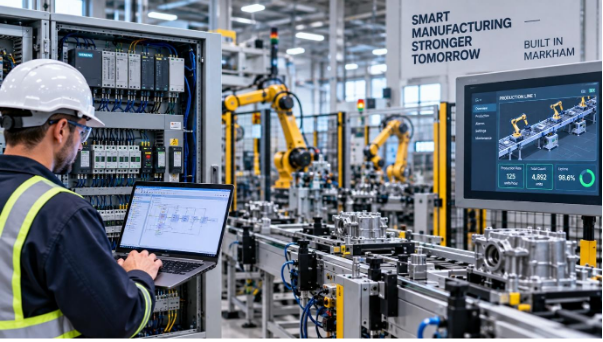

Walk into a modern manufacturing facility in Markham and there is a good chance you will see machines doing several jobs at the same time.
Robotic equipment moves parts. Sensors check positions. Motors control movement. Operators monitor production from HMI screens. Machines send signals to other machines so the next step can begin.
A PLC sits behind much of this activity.
It tells equipment when to start, when to stop and what to do when something does not go as expected. When the PLC program is set up properly, the equipment can follow a clear sequence and operators can see what is happening.
For Markham manufacturers, PLC programming can support new automated equipment, existing machinery, production lines, control panels, HMI systems and automation upgrades.
Why PLC Programming Matters in Advanced Manufacturing
Modern manufacturing is not simply about running one machine.
A production cell may have a robot, sensors, conveyors, drives, safety devices and an HMI working together. Each part has a job, but the whole system needs to work as one.
The PLC manages that coordination.
For example, a machine may need to confirm that a part is in the correct position before a robot can begin its operation. The robot then completes its task and sends a signal back to the PLC. The PLC checks the required conditions and allows the next machine to start.
If one signal is missing, the sequence needs to stop or respond in the correct way.
That is why PLC programming has such an important place in automated manufacturing.
PLC Programming for Automated Manufacturing Equipment
Automated equipment can perform repetitive tasks quickly and consistently, but the control system needs to keep everything in the right order.
A PLC can control equipment such as:
Motors
Sensors
Conveyors
Robotic systems
Pneumatic equipment
Drives
Pumps
Valves
Inspection equipment
Automated assembly machines
The program tells the equipment how to respond to different inputs.
A sensor may detect a component. The PLC receives the signal and starts the next operation.
A motor may reach its required position. The PLC can then allow another machine to continue.
A safety condition may change. The PLC can stop the relevant equipment.
These actions happen very quickly, often without an operator having to intervene.
Keeping Automated Production Lines Moving
Production lines depend on timing.
If one machine takes longer than expected, another machine may have to wait. If a sensor fails to detect a part, the next step cannot safely begin.
The PLC manages these conditions through control logic.
A production sequence may look simple:
1.Detect the part.
2.Position the part.
3.Start the machine.
4.Complete the operation.
5.Confirm the result.
6.Move the part to the next station.
In an actual production environment, there may be dozens of conditions behind each step.
The PLC checks these conditions and makes sure the equipment follows the required sequence.
Good programming also considers what happens when something goes wrong.
A part may not arrive.
A sensor may remain active.
A motor may fail to start.
A robot may not complete its cycle.
The control system needs to respond properly instead of leaving the operator guessing.
PLC and HMI Programming
The PLC controls the equipment, but operators need a clear way to see what the system is doing.
That is the job of the HMI.
An HMI can display machine status, alarms, process information and operating controls. It can also give maintenance staff useful information when something stops.
Imagine a production machine that suddenly stops.
A basic message might simply say that the machine has a fault.
A useful HMI can provide more information. It may show that a sensor did not detect a part, a motor did not reach the required speed or a particular condition is preventing the next step.
That small difference can save a lot of time during troubleshooting.
For Markham manufacturers, PLC programming can involve both PLC logic and HMI programming so the operator interface reflects what is happening inside the machine.
Connecting Robots and Automated Equipment
Robots are now common in many manufacturing applications.
A robotic cell may handle parts, perform assembly, move products, weld components or carry out repetitive operations.
The robot does not work alone.
It may need signals from the PLC before starting a cycle. The PLC may also need a signal from the robot before allowing the next part of the production process to begin.
This creates a constant exchange of information.
The PLC may check:
Is the robot ready?
Is the part in position?
Is the safety circuit ready?
Has the previous operation finished?
Is the next station available?
Has the robot completed its cycle?
Only after the required conditions are met should the next operation begin.
This type of coordination is an important part of automated equipment programming.
PLC Programming and Machine Safety
Safety needs to be considered when automated equipment is programmed.
Machines may have doors, emergency stops, light curtains, safety switches and other devices designed to protect people working around the equipment.
The control system needs to respond correctly when a safety condition occurs.
For example, opening a guarded area may require certain equipment to stop. The system should also prevent the machine from restarting unexpectedly.
The exact safety arrangement depends on the machine and its design.
PLC programming can form part of the wider control system that manages these conditions, alongside the appropriate safety hardware and engineering practices.
Troubleshooting Automated Equipment
When automated equipment stops, the first reaction is often to reset it.
Sometimes that gets the machine running again.
But if the same fault keeps returning, the reset does not solve the actual problem.
PLC troubleshooting looks deeper.
The programmer can check the control logic and see what condition is stopping the sequence. Inputs, outputs, sensors, alarms, drives and communication signals can all be reviewed.
For example, a conveyor motor may not be starting because the PLC is waiting for a signal from another machine.
The motor itself may be perfectly fine.
Without looking at the control logic, it would be easy to spend time checking the wrong component.
A clear PLC program makes this type of fault much easier to trace.
Updating Existing PLC Programs
Many manufacturing plants have equipment that has been running for years.
The machine may still perform its job, but the PLC program may have changed many times over its working life.
Someone may have added a new sensor. Another person may have changed a sequence. An old HMI screen may still be in use.
Over time, the original program can become difficult to follow.
A PLC review can help identify areas that need improvement.
This may include:
Reviewing existing control logic
Checking inputs and outputs
Improving alarm messages
Updating HMI screens
Removing unnecessary logic
Adding new machine functions
Improving documentation
Checking communication between equipment
Planning hardware upgrades
The goal is not to change things simply for the sake of change.
If the equipment is working properly, unnecessary changes can create new problems.
The better approach is to identify the actual issue and make the required improvements.
Supporting Older Automation Systems
Older PLC hardware can create problems when replacement parts become difficult to find or when the people familiar with the original programming are no longer available.
This is a common concern for plants that have been operating the same equipment for many years.
A control system review can help identify what is still working well and what may need attention.
A plant may need to keep the existing PLC for now while preparing for a future upgrade.
In another case, only part of the system may need to be changed.
Planning ahead gives the maintenance team more time to prepare backups, review the existing program and schedule the work around production.
Industrial Communication Between Machines
Modern automated equipment needs to exchange information.
A production cell may have several PLCs, HMIs, drives, robots, remote I/O and other devices.
Industrial communication allows these devices to share information.
For example, one PLC may tell another machine that a part is ready. A drive may send operating information back to the PLC. An HMI may display the status of several machines on one screen.
When communication fails, the equipment may stop even though the mechanical parts are working correctly.
That is why communication needs to be considered during PLC programming and system integration.
PLC Programming for New Equipment
A new machine should not simply be connected and switched on.
The control system needs to match the way the machine will be used.
Before programming begins, the required machine sequence should be clear.
What starts the process?
What stops it?
What happens when a sensor does not respond?
What happens after a fault?
What information should the operator see?
How should the machine communicate with other equipment?
These questions affect the PLC program.
A good program reflects the actual operation of the machine rather than forcing operators to work around the control system.
PLC Programming for Markham Manufacturers
Markham is home to businesses involved in manufacturing, technology, industrial equipment and automated production.
For these companies, automation can be a major part of daily operations.
A production problem can affect the entire schedule.
A machine that stops unexpectedly can hold up the next operation. A communication problem can prevent two machines from working together. An outdated PLC can make a simple modification much harder than it needs to be.
This is where local PLC programming support can be useful.
PLC Programming Markham can cover new PLC applications, existing program modifications, HMI programming, troubleshooting, system integration and control system upgrades.
When Should You Review Your PLC Program?
You do not need to wait for a major failure before looking at the control system.
A review can make sense when you notice:
Frequent machine stoppages
Repeated alarms
Difficult fault diagnosis
Outdated HMI screens
Missing PLC backups
Unclear machine sequences
Communication problems
New equipment being added
Changes to an existing production process
Older PLC hardware
Operators relying on frequent manual resets
These signs do not automatically mean that a complete system replacement is required.
Sometimes a small change to the program can fix a recurring problem.
In other cases, a larger upgrade may make more sense.
The right answer depends on the equipment, the existing control system and the problem being experienced.
A Practical Approach to PLC Programming
Good PLC work starts with the machine itself.
The programmer needs to see how the equipment operates, how the different components interact and what operators need during normal production.
The existing PLC program should also be reviewed before major changes are made.
From there, the required modifications can be developed, tested and commissioned.
Documentation is important too.
A clear record of the updated PLC program, HMI files and system changes gives the maintenance team something useful to refer to later.
That becomes especially valuable when another modification is needed several months or years down the road.
Keeping Markham’s Automated Equipment Reliable
Automation can make production faster, but it also means that many parts of a facility depend on the control system working properly.
The PLC sits at the centre of many of these operations.
It manages machine sequences, responds to sensors, communicates with equipment and helps operators see what is happening.
When the programming is clear and the system is properly maintained, problems are easier to trace and changes are easier to manage.
For manufacturers in Markham, PLC programming can support automated equipment, production lines, robotic applications, HMI systems, troubleshooting and control system upgrades.
The aim is straightforward: keep machines working as intended, make faults easier to find and give operators a control system they can rely on.